





JPX925 Hot Metal Pro Irons w/ Steel Shafts – Mizuno Golf Iron Set Club: Product Review
Introduction
The Mizuno JPX925 Hot Metal Pro Irons (Steel Shafts) are a premium iron set positioned in the
“players distance” category—designed for golfers who want a cleaner, more compact look than a traditional game-improvement
iron, while still benefiting from modern distance and forgiveness technologies. Priced at $1049.99,
this set targets mid-to-low handicappers (and improving golfers) who prefer the consistency and feedback of steel shafts,
but don’t want to give up help on off-center strikes.
Overview (Manufacturer, Category, Intended Use)
- Manufacturer: Mizuno
- Product Category: Golf irons (players-distance / game-improvement blend)
- Intended Use: Approach shots and tee shots on par 3s; designed to provide strong ball speed, workable trajectory control, and playable forgiveness
- Target Golfer: Players who like a “Pro” profile at address but want extra speed and stability compared with a traditional forged players iron
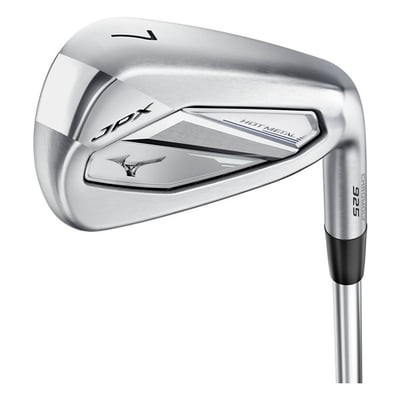
Appearance, Materials, and Aesthetic
In keeping with the “Pro” naming, the JPX925 Hot Metal Pro irons typically emphasize a more refined shape than
the standard Hot Metal line: a thinner top line, less offset, and a more compact profile that better suits golfers who
are sensitive to how an iron frames the ball. The overall styling is modern and performance-forward rather than overly
ornate—aimed at golfers who want a clean, confidence-inspiring look in the bag and at address.
While exact construction details (e.g., face material, internal weighting, and finishing specs) aren’t provided in the
data here, the “Hot Metal” family is generally associated with distance-oriented design, and the steel shaft
configuration will appeal to players prioritizing consistent tempo, tighter dispersion, and clear strike feedback.
Notable design cues (typical of “Pro” variants): reduced offset, more compact head, and a sleeker
silhouette intended to look less bulky than maximum-forgiveness irons.
Key Features / Specifications
Based on the product title and category positioning, the key takeaways for this set are:
- JPX925 Hot Metal Pro iron heads: a “Pro” shape focused on a cleaner look and improved workability
- Steel shafts: typically favored for consistent launch/spin characteristics, dispersion control, and feedback
- Designed for distance + forgiveness: “Hot Metal” branding commonly implies ball-speed-oriented construction and stability on mishits
- Premium set pricing: positioned as a higher-end option for golfers investing in long-term performance
Note: Specific lofts, lie angles, swing weights, stock shaft model, set composition (e.g., 4-PW), and grip details
are not included in the provided product data. Prospective buyers should confirm those specs with the retailer or Mizuno
to ensure the build matches their gapping and fit needs.
Performance and Real-World Use (Various Scenarios)
1) Full Approach Shots (Fairway / Good Lie)
Where a “Hot Metal Pro” style iron set tends to shine is in producing strong, repeatable distance with a
more player-friendly look. With steel shafts, the overall feel is typically stable through the swing, rewarding
a confident strike with a penetrating flight. Golfers who tend to deliver the club consistently should appreciate
predictable yardages and a solid sense of where the face is at impact.
The “Pro” shaping can also help alignment and confidence for players who dislike thick top lines or substantial offset.
If you are coming from a blade or players cavity, the transition can feel more natural than switching into a large
game-improvement head.
2) Off-Center Strikes (Toe/Heel Misses)
Players-distance irons are generally engineered to preserve ball speed and reduce harsh distance loss when contact
drifts away from the center. In practical terms, this can mean a shot that still reaches the front edge of the green
instead of coming up significantly short. That said, the “Pro” version typically won’t be as forgiving as the most
oversized super game-improvement irons—so golfers with very inconsistent strike patterns may still see meaningful
directional and distance penalties on big mishits.
3) Rough and Flyers
From light-to-moderate rough, the iron’s distance-oriented construction can be a benefit and a risk:
you may get enough speed to still advance the ball a useful distance, but rough can also reduce spin and lead to
“flyers” that launch higher and run out more than expected. If your home course has thick rough, pay attention to
spin consistency and stopping power—especially with mid irons.
4) Windy Conditions
Steel-shafted irons often help players keep a controlled tempo and produce consistent launch windows. In the wind,
the goal is usually to manage trajectory and spin. With a players-distance iron, you can often flight the ball down,
but depending on your delivery and the set’s loft design, some golfers may see a naturally higher launch. If you
frequently play in heavy wind, proper fitting (shaft profile and lie/loft optimization) becomes especially important.
5) Greenside / Partial Shots
Partial shots—like a “three-quarter 9-iron” or a controlled knockdown—are where the “Pro” profile can be appealing.
Many golfers find it easier to vary face control and trajectory with a more compact head. Still, distance-oriented
faces can sometimes feel a touch “hot” on certain strikes, so dialing in partial-swing carry distances may take a
bit of practice compared with more traditional, softer-feeling players irons.
Pros and Cons
Pros
- Players-friendly look: “Pro” shaping typically offers a cleaner, more compact profile at address
- Distance-oriented performance: designed to generate strong ball speeds and modern carry
- Steel shaft consistency: often improves dispersion control and provides clearer strike feedback
- Good blend of forgiveness and workability: more help than traditional players irons without a bulky appearance
- Premium build positioning: suited for golfers looking to invest in a long-term set
Cons
- Price: at $1049.99, it’s a significant purchase and may compete with other premium sets and custom-fit options
- Not maximum forgiveness: golfers needing the most help on mishits may prefer larger game-improvement irons
- Spec clarity needed: lofts, set makeup, and stock shaft details aren’t provided here—buyers should verify to ensure proper gapping
- Potential “hot face” learning curve: some players-distance designs can require extra time to dial in partial-shot distances
Conclusion
The Mizuno JPX925 Hot Metal Pro Irons w/ Steel Shafts are best viewed as a premium
“bridge” set: they aim to deliver the speed and forgiveness many golfers want, while maintaining a more refined,
player-preferred profile at address. For golfers who value a clean look, consistent steel-shaft feel, and modern
distance in an iron that still allows some shot shaping and trajectory management, this set is a compelling option.
The biggest considerations are fit and expectations: confirm the exact set composition and specs,
and be realistic about forgiveness needs. If your ball striking is improving and you want an iron that can grow with
you—without jumping all the way to a demanding players blade—this JPX925 Hot Metal Pro configuration is likely to
deliver a strong blend of performance and confidence.



Reviews
There are no reviews yet.